

1. Robotics Is Moving from Concept to Commercial Reality
Robotics was once treated as something from science fiction. Today, patent data tells a very different story: the industry has clearly entered a phase of rapid real-world deployment. In Beijing, the 2025 World Humanoid Robot Games brought together teams from 16 countries and regions, underscoring how far cutting-edge robotics has moved beyond the lab and into complex, real-world environments. Looking back, robotics has advanced dramatically since the first autonomous industrial robot patent was filed in 1954.
The commercial scope of robotics has expanded sharply. In logistics, Amazon has deployed more than 1 million robots across its operations network. In food service, companies such as Chipotle have introduced automated kitchen solutions, while Tesla has been testing the service interaction capabilities of Optimus in newer commercial settings. These examples show that robots are no longer limited to heavy industrial machinery; they are increasingly embedded in high-frequency, high-precision business and service scenarios.

2. Patent Data as an Objective Indicator of Core Technology
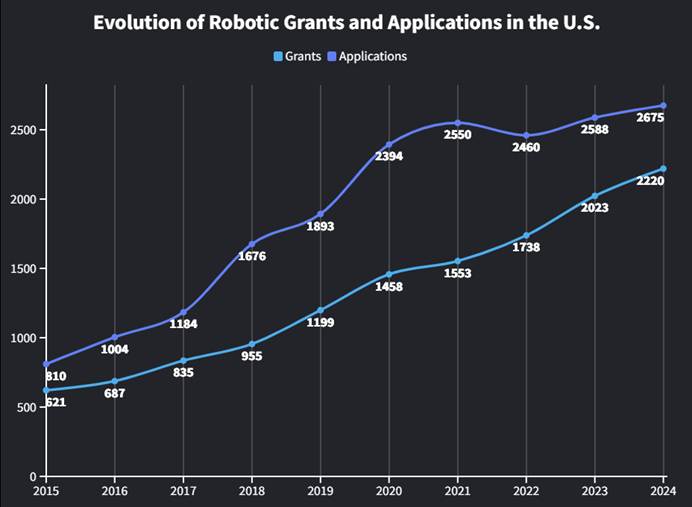
When assessing the development of frontier technologies, patent data is one of the most objective ways to measure both R&D intensity and technological maturity. According to IFI CLAIMS, U.S. grants for general robotic patents have grown at an annual rate of 15.21% over the past 10 years, while applications have increased by 14.2%. In the past five years alone, companies filed more than 12,000 robot-related inventions with the USPTO, nearly double the number from the previous five-year period.
Behind that surge is a strategic race among global leaders to secure the high ground in core robotics technologies. In this context, patent trends do more than reflect innovation activity; they also reveal where companies are placing their long-term bets.
3. Global Competition and Leading Players
On the corporate side, LG Electronics in South Korea has secured more than 1,000 U.S. robotics-related patents over the past five years. LG has also expanded its robotics strategy through its investment in Bear Robotics, strengthening the commercial reach of its CLOi robot systems across hospitality, healthcare, and home-use scenarios.
From a regional perspective, among the global top 50 companies filing robotics patents in the United States, U.S.-based companies account for 40%, Japan for 24%, and Germany and South Korea for 8% each. This distribution shows that robotics R&D has become a deeply global technology contest.
4. A High-Growth Segment: Surgical Robots
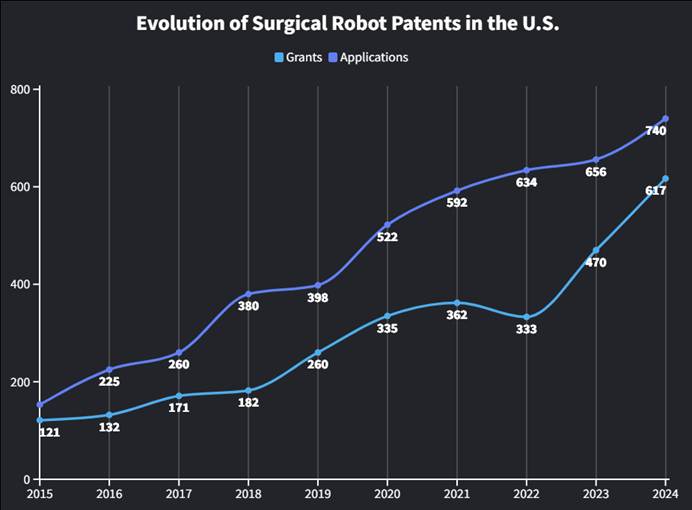
A closer look at patent classification codes shows that the hottest segment is not traditional industrial manufacturing, but medical surgical robotics, primarily centered on CPC code A61B 34/30. Closely behind it are vision-controlled systems, surgical navigation, and computer-assisted interface technologies.
Healthcare places extremely high demands on precision, stability, and safety. Robotics can significantly improve surgical accuracy and lower the barrier to minimally invasive procedures. In this high-barrier segment, leading companies have built especially dense patent portfolios.
Verb Surgical, founded by Johnson & Johnson and the former Google Life Sciences, has focused on surgical consoles, human-machine interaction, and core operating-system design. Covidien and Auris Health have built patent barriers in multi-camera coordination and in-body micro-operation workflows. Intuitive, one of the industry’s best-known leaders, has accumulated millions of clinical procedures on its da Vinci system. Its latest generation of equipment is also advancing haptic feedback technology to further refine the surgeon’s sense of touch during procedures.
5. Patent Value: From Volume to Forward Citations
Evaluating the value of a company’s patent assets requires more than counting total filings. Citation patterns matter just as much. Backward citations show which earlier technologies a patent builds on, and therefore reflect its technical lineage and prior-art foundation. Forward citations show how often a patent is cited by later patents after publication.
Forward citations are a key indicator of technological value. High forward-citation counts usually mean that a technology has solved a core industry pain point and generated strong spillover effects. For companies, reading these signals correctly makes it possible to identify where the next wave of technological interest is likely to emerge. Current patent trends suggest that robotics will continue to converge with artificial intelligence, biotechnology, and high-precision micromanipulation.
6. Conclusion
From industrial manufacturing to high-end healthcare, every step forward in robotics depends on global R&D and a strong patent system. Patents are not only records of innovation; they are also critical intangible assets and legal barriers in international competition. In fields with high technical thresholds and rapid iteration, such as robotics, AI, and medical devices, the quality of patent translation directly affects the security and enforceability of a company’s technology assets. Patent translation is never just a language exercise. It requires precise rendering of complex technical logic while also respecting the legal terminology boundaries of different jurisdictions.
As a professional language service provider, Glodom understands the value of core technology. Whether the content involves micro-level algorithmic control or advanced medical device structures, we are committed to delivering rigorous, accurate, and high-quality patent localization services. Our goal is to ensure that your technical details are conveyed precisely and your legal interests are properly protected, supporting your innovation strategy and global expansion with confidence.
Source Note
Original source: IFI CLAIMS. This article has been adapted from the original. Glodom does not own the original copyright and assumes no related legal responsibility. The views expressed are those of the original author and do not represent Glodom’s official position. The content is provided for reference and learning purposes only. If you believe any content infringes your rights, please contact info@glodomtec.com for removal.
About Glodom
Glodom is an innovative language technology solutions provider with extensive project experience in the patent services field and long-term partnerships with many Fortune Global 500 companies and professional institutions. Glodom has more than 300 full-time employees and a network of over 10,000 native-speaking translation experts across more than 40 countries worldwide. We support more than 200 languages and provide efficient, accurate language support for patent filing, patent translation, patent invalidation, patent litigation, and related technical materials.We consistently balance professional capability with service efficiency. With a mature terminology management system, rigorous quality control processes, and extensive cross-language project experience, we continue to help companies address language challenges in international patent matters and strengthen compliance and competitiveness in global expansion.
