

On May 22, tcworld China 2026 came to a close in Shanghai. As one of Asia’s leading international conferences for professionals in technical communication, content, language, and product experience, the event brought together technical writers, content architects, and localization professionals not only to discuss industry trends, but also to rethink the boundaries of language technology.
Glodom made a strong appearance as an active participant. Against the backdrop of large language models and AI continuing to reshape the language services industry, Glodom shared its observations and practices through three presentations from different angles.
1. When Translation Meets DevOps: The Next Decade of
Language Services
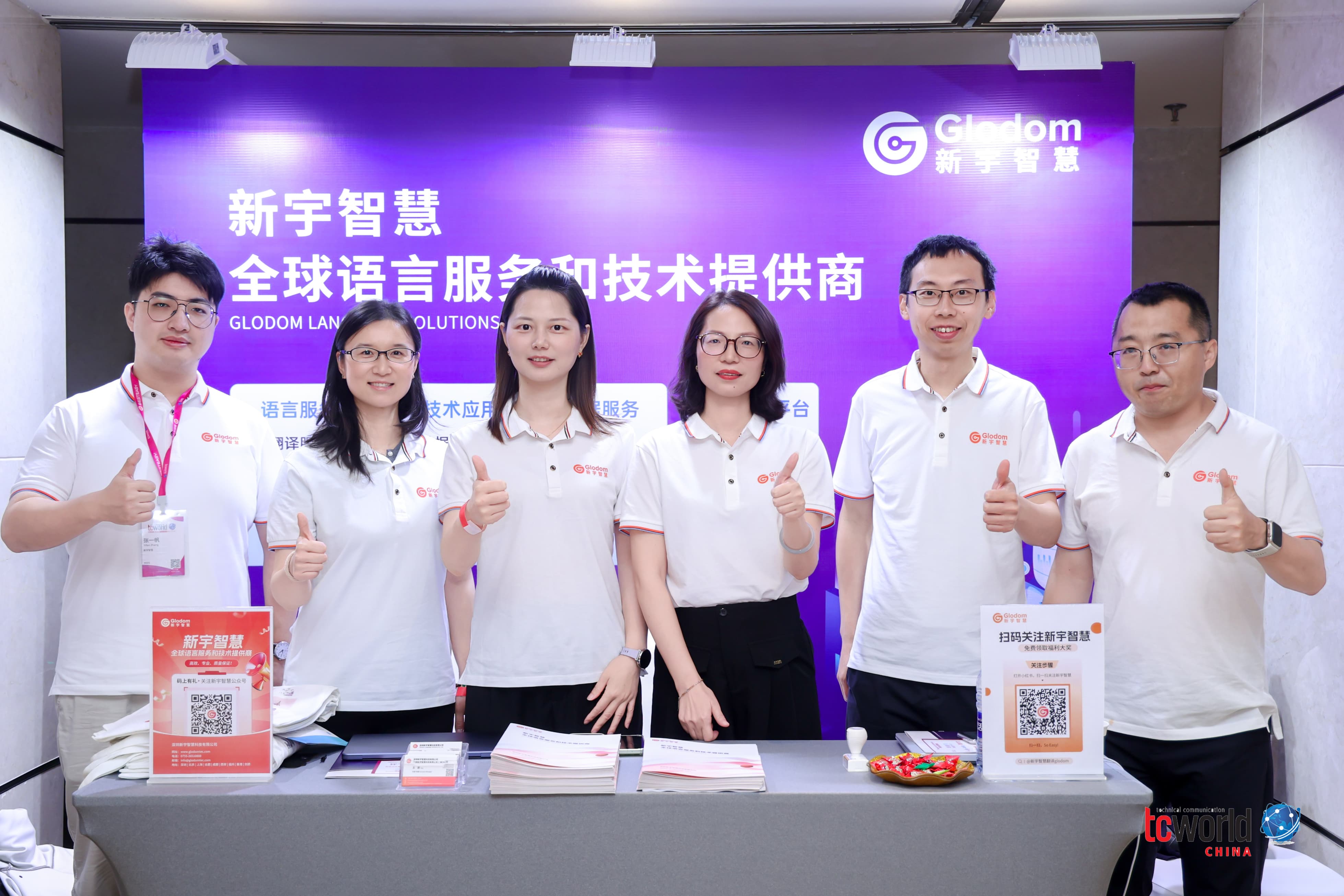
Glodom Product Director Zhang Yifan opened
with a presentation titled When Translation Meets DevOps: The Next Decade of
Language Services, focusing on where language service workflows are headed.
Today, clients are asking for more at the
same time: faster delivery, higher translation quality, consistent terminology,
a strong brand voice, and tighter cost control. Under these pressures, the
traditional MTPE model, which relies heavily on manual, linear workflows, is
increasingly reaching its efficiency limits.
For language services to truly move
forward, the answer is not simply to “use AI.” Instead, Glodom believes the
industry should draw on the DevOps mindset from software engineering and
connect translation, review, version management, issue handling, and language
asset accumulation into one continuously running production pipeline. In this
way, language services can evolve from a manual, experience-driven model
dependent on individual effort and fragmented collaboration into a
standardized, traceable, rollback-ready, and continuously improvable
engineering system.
Building on this idea, Zhang went on to
explain retry and fallback mechanisms in translation agents, the architecture
of automated QA tools, and how rules engines, LLM-based semantic understanding,
result validation, and version rollback can help turn AI from a point solution
into an auditable, closed-loop production capability that can truly support
stable delivery in complex projects.
The core message of this talk was clear:
language services should move from “one-off completion” to “continuous
operation,” and from project-based collaboration driven by individual
experience to an engineering system with standardized processes and continuous
iteration capabilities.
2. From Managing People to Managing People + Digital
Employees
Once workflows are reorganized, a new
question naturally emerges: how can these AI-driven capabilities truly enter
the enterprise and become part of daily operations in a stable way?
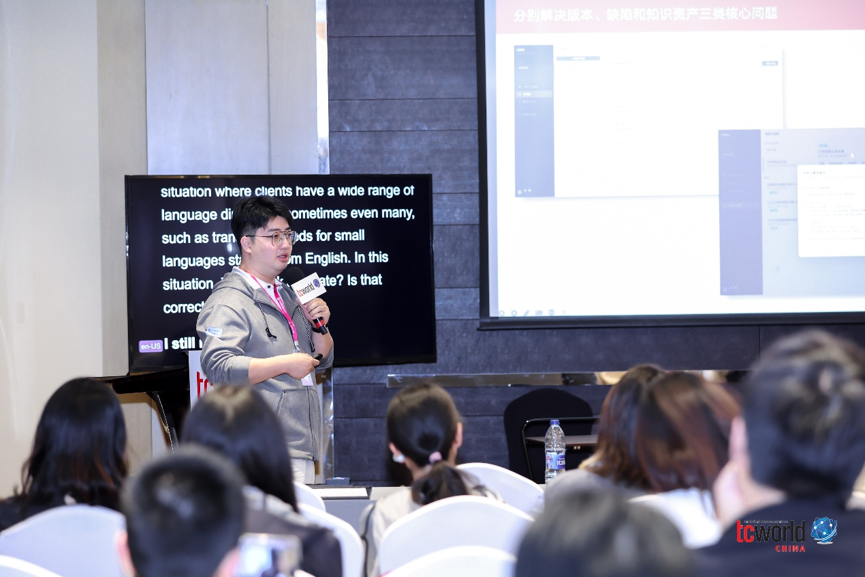
Glodom R&D Director Wang Boli addressed
this challenge by sharing an enterprise governance approach for intelligent
agent management platforms. Through a practical explanation of how language AI
can be deployed in vertical scenarios, he described the shift from “managing
people” to “managing people + digital employees.”
As large models gradually move inside
organizations, the real issue is no longer just individual productivity. The
real challenge is how to make organizational capabilities run in an automated
and scalable way.
The most common contradiction enterprises
face today is this: employees using AI on their own can usually solve isolated
problems, but what businesses actually need is a unified mechanism that can
operate across departments, systems, and workflows. In his talk, Wang broke
down the practical challenges of scaling AI in enterprise environments.
Individual use of AI often remains a kind of craft work, relying on personal
experience. But without centralized planning, agents can easily become siloed
AI scattered across different departments, creating data islands, uncontrolled
permissions, version chaos, and hidden costs.
To address this, Wang presented Glodom’s
approach to platform-based development and systematic governance, including
modules for task management, Agent management, application onboarding, model
onboarding, and analytics, as well as a closed-loop workflow covering
assignment, execution, delivery, and measurement. With this four-layer
architecture and workflow framework, agents are no longer just separate tools.
They become an organizational capability that can enter business processes, run
reliably, and be reused over time.
3. Good Data Makes Good Translation: Key Practices in
Parallel Corpus Filtering
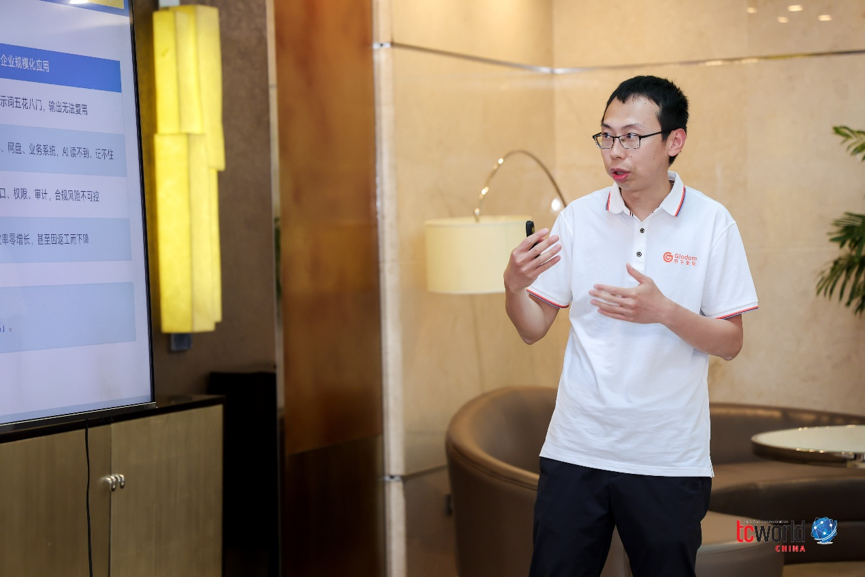
At the technology showcase, Glodom Data
Engineer Chen Wenkai focused on the importance of data quality at the
foundation of language AI in his presentation, Good Data Makes Good
Translation: Key Practices in Parallel Corpus Filtering.
The ceiling of model performance and
translation quality often depends on whether the underlying parallel corpora
are clean, stable, and usable. In real projects, however, noise is everywhere:
leftover web content, garbled advertisements, mismatched source and target
sentences, and traces of machine translation. These issues may seem small, but
they can directly affect training signals, terminology consistency, and the
stability of translation style.
To tackle this challenge, Chen shared
Glodom’s practical approach to corpus filtering. The process begins with source
evaluation, followed by format cleanup, language identification, and alignment
checks. It then moves on to rule-based filtering, semantic consistency checks,
quality tiering, and, finally, manual spot checks and feedback-driven
optimization. In other words, filtering is not a one-time deletion step. It is
a continuous data quality system that keeps improving over time.
4. Conclusion
Taken together, the three presentations
moved from workflow to architecture and then to data, but they all pointed in
the same direction: competition in language AI is no longer just about model
capabilities. It is increasingly about workflow redesign, platform governance,
and data quality working together.
Through tcworld China 2026, Glodom not only
showcased its latest progress in language technology and intelligent
operations, but also presented a more systematic view of where the industry is
headed. As technical communication and global content production continue to
accelerate, workflow, architecture, and data are becoming the new
infrastructure of the language services industry, opening up new possibilities
for enterprises to achieve more efficient, stable, and sustainable global
collaboration.
