

When a company takes a Chinese patent into
overseas markets, one practical question tends to come up very quickly: how
should the patent documents be translated?
There is usually little debate over the
need to protect the claims with professional translation. But descriptions can
run for dozens of pages and contain a great deal of repetitive content.
Translating every page manually can add significantly to both cost and
turnaround time. That is why many companies consider a more straightforward
approach: use machine translation for the description first, then have a human
review the output.
From a cost-control perspective, the idea
is easy to understand.
But PCT applications come with a point that
is easy to overlook: translating a PCT application is not simply a matter of
converting a Chinese technical document into another language.
The PCT provides an international patent
application procedure. Once an application enters the international phase, it
goes through an international search and an International Search Report and
Written Opinion are established. If the applicant wishes to continue seeking
patent protection in specific countries or regions, the application must then
enter the relevant national or regional phase. The current PCT Applicant’s
Guide also distinguishes clearly between the international phase and the
national phase, while the requirements for language and procedure may differ
from one designated Office to another.
In other words, language work on a PCT
application never really ends when the translation is delivered.
The translation needs to support the
search, examination, amendments and subsequent national phase procedures that
may follow.
That is why the more useful question is not
whether a machine can translate the description. The real question is whether a
company can place different types of risk into the right part of the workflow.
1. Does the Description in a PCT Application Only Need to
Explain the Technology Clearly?
When companies deal with patent
translation, they naturally tend to focus more attention on the claims because
the claims define the subject matter for which protection is sought. The PCT
International Search and Preliminary Examination Guidelines also make clear
that claim clarity is important when assessing whether an invention appears to
be novel, to involve an inventive step and to be industrially applicable. But
across the patent document as a whole, the description serves a different
purpose.
The claims set out the technical solution
for which protection is sought. The description provides the technical
background, explains the invention, describes specific embodiments and refers
to the drawings, helping the reader understand what the technical solution is,
how it can be implemented, and in what technical context its features apply.
This means that the description is not
simply a collection of independent paragraphs.
A technical feature may first appear in the
discussion of the invention, then reappear in the detailed description, be
explained further in a particular embodiment with relevant parameters, and
finally be shown again in the drawings.
Take a mechanical invention involving a
“pressure-regulating assembly.”
It may first appear in a claim and then be
broken down in the description into components such as a valve body, an elastic
element and a control rod. In the embodiment section, the document may
introduce a pressure range, an operating temperature and the way the different
components are connected.
Translating any one sentence is not
necessarily difficult.
The real challenge is making sure that,
dozens or even hundreds of pages later, all of those pieces of information
still point accurately to the same technical solution.
In patent descriptions, the hardest part is
often not the length of an individual sentence. It is the way technical
information moves between different levels of the document.
Machine translation is good at generating
language based on local context. Patent documents, however, often require
decisions that span paragraphs, sections and sometimes the entire document.
Those are not quite the same problem.

2. The Real Challenge in PCT Translation Is Keeping the
Technical Meaning Intact
In ordinary technical translation,
replacing one synonym with another may not cause much trouble. In a patent, it
can.
Words and phrases such as “comprising,”
“including,” “at least one,” “substantially,” “about,” and “preferably” may
look like ordinary language, but in a patent context they are not simply
matters of style.
In particular, wording used in the claims
needs to reflect the technical limitations and the way such limitations are
conventionally expressed in patent language. The PCT International Search and
Preliminary Examination Guidelines specifically address claim wording and the
assessment of novelty, inventive step, industrial applicability, clarity and
support by the description.
This is where a common misconception can
cause problems. It is not that each Chinese term must always correspond to one
fixed English term. What matters is whether the translation preserves the
technical relationships expressed in the original document.
For example:
“at least one
sensor” is clearly not the same as “one sensor”;
“about 50°C” is not
simply interchangeable with “50°C”;
and “A is preferably used” does not have
exactly the same meaning or level of limitation as “A is used.”
If a machine processes these expressions as
ordinary near-synonyms, the resulting sentence may still read smoothly, while
the technical limitation has already shifted.
Professional patent translation is
therefore not a simple exercise in building a Chinese-to-English word list. The
first step is understanding what each term is doing in context.
What role does the term play here?
Is it defining a technical feature, or
describing an embodiment?
Is it limiting a quantity or range, or
presenting an optional approach?
Only after those relationships are clear
can the translator determine how the concept should be expressed in the target
language.

3. Some Problems Are Not Translation Errors at All—they
Happen During File Processing
Patent projects also involve another
category of problems. The language itself may not be difficult for a machine to
translate, yet errors can still appear during automated processing.
File structure is a good example.
A patent description may contain body text, tables, equations, drawings, reference signs, chemical formulas, sequence listings and a range of special formatting. Machine translation may process the body text without any obvious problem, but the finished file still needs to answer a series of practical questions:
Were all the words in the drawings handled?
Do the figure numbers still correspond to the references in the text?
Were any units in the formulas processed incorrectly?
Do the values in the tables match those in the description?
Have the headers, footers, footnotes or
cross-references changed?
For a patent, these issues cannot simply be
treated as formatting problems.
Under PCT Rule 49.5, where a designated
Office requires a translation for national phase entry, the translation of the
international application includes the description, claims, any text matter in
the drawings and the abstract. Where drawings contain text, the translated text
must be provided in the prescribed form.
This is why mature patent translation
projects usually need linguistic work and document production work to happen
together.
Drawings are particularly important.
There may not be much text in a patent
drawing, but that text is tightly connected to the component names, reference
signs and technical relationships used in the description. PCT requirements
also call for consistency in reference signs throughout the description and
drawings, and the same feature should be identified by the same reference sign.
For patent translation, then, “translation
completed” and “file ready for delivery” are actually two different milestones.
4. Once the Application Enters the National Phase, the
Translation Faces Different Language Environments
One of the defining features of the PCT is
that an international application can provide a common framework for subsequent
patent procedures in multiple countries or regions.
This matters a great deal in practice.
Suppose a company plans to enter the United
States, Japan and Germany.
What it needs to deal with is not simply
“translate the Chinese description into English, Japanese and German.”
The three markets may have different
language requirements, different documents required for national phase entry
and different examination and response environments later on.
That is why a well-structured PCT language
project should identify the target jurisdictions and intended downstream use
before translation begins.
Preparing a translation solely for national
phase filing is not the same project as preparing language assets that will
also support later examination, responses and even long-term patent
maintenance.
The first approach is primarily concerned
with procedural accuracy and filing requirements. The second places greater
emphasis on long-term terminology management, historical translations and
traceability when amendments are made later.
The earlier a company makes that
distinction, the easier it becomes to manage language costs downstream.
The WIPO guide notes that the languages
accepted for national phase entry are set by the relevant designated Offices,
and the translation requirements may differ from one Office to another.
5. So, Does the Entire Description Need to Be Translated
by Humans?
Not necessarily.
When a description contains a large amount
of repetitive technical language, fixed structures and established terminology,
completely excluding machine translation may not be the most efficient
approach.
What really needs to change is where human
effort is applied.
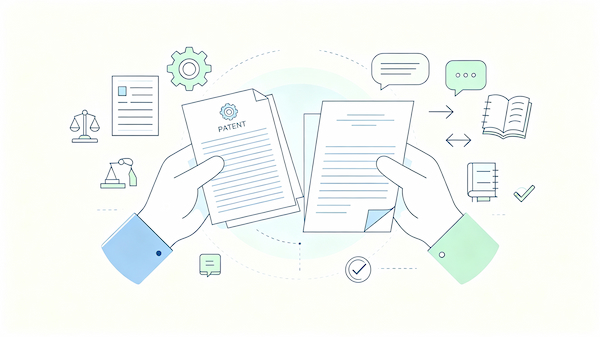
A more practical workflow can be divided
into several layers.
5.1 Machine Translation
Use the system for large-scale initial
translation, repetitive content and terminology matching, helping reduce the
time required for the first pass.
5.2 Professional Translators
Translators focus on areas where machine
translation is less reliable, including core technical features, complex
sentence structures, specialized terminology, qualifiers, parameter
relationships and ambiguities in the Chinese source text.
5.3 Patent-Language Review
This stage goes beyond checking whether the
English is grammatically correct. The reviewer checks the technical
relationships among the claims, description, embodiments and drawings to make
sure the language conversion has not introduced ambiguity, omitted information
or shifted the technical meaning.
The PCT Guidelines themselves emphasize the
relationship between the claims and the description, including the requirement
that the claims be fully supported by the description and drawings and that the
disclosure be sufficiently clear and complete for the invention to be carried
out by a person skilled in the art.
5.4 Document-Level QA Before Delivery
At this point, the focus is no longer a
single sentence. The entire document needs to be checked for numbering, figure
numbers, terminology, values, units, formatting, cross-references and version
control.
This kind of workflow is often more
practical for today's patent projects than either extreme: translating
everything manually or sending everything straight through machine translation.
Machines handle scale. People handle
judgment.
6. What PCT Translation Really Needs to Manage Is What
Happens Next
A patent document may go through a long
journey from its filing in China, through the PCT international phase, and then
into the national phase in multiple countries or regions.
Along the way, there may be new versions of
the claims, a Written Opinion issued during the international phase, and later
office actions or amended texts after national phase entry.
That means companies should not evaluate a
translation approach solely on the cost of the first delivery.
There is another practical question worth
asking: when the patent needs to be amended a year from now, who will still be
able to identify the terminology, document version and corresponding
translation used at the time?
A company may save some money today by
sending different versions of the document through different tools. But if the
same technical feature ends up with different translations later in the
prosecution process, the cost of reconciling them may be much higher.
That is one reason language asset
management is becoming increasingly important in the patent field.
Terminology databases, translation
memories, historical project corpora and QA rules are not valuable simply
because they make today's document faster to translate. Their greater value
lies in allowing the company to reuse established language assets for its next
patent, the next round of amendments and the next target market.
For companies with ongoing overseas patent
strategies, that accumulated language asset may matter more over time than a
small difference in the price of a single translation project.
7. So, Can the Description Be Sent Straight to Machine
Translation?
Machine translation can absolutely be part
of the workflow.
But “machine translation completed” should
not be treated as “patent translation completed.”
A PCT application sits within a continuous
process that can extend from the international application through the national
phase and into specific examination procedures. During the international phase,
the International Search Report and Written Opinion are established, and the
results can support subsequent consideration by national or regional Offices.
In that process, a description needs to do
more than read fluently.
Its technical features need to remain clear
and accurate. Key wording needs to stand up to later review. The drawings and
description need to be checked against each other. And when amendments are made
later, the corresponding terminology and translation should still be easy to
trace.
So the more practical question is not
whether to choose “fully human” or “fully machine.”
It is: which parts are suitable for
automation, and which decisions still need to be made by professionals?
For companies looking to control PCT
translation costs while maintaining a reliable foundation for long-term
overseas patent strategies, that may be the more useful language question to
ask.
At Glodom, our PCT and intellectual
property language service projects are structured around the document type,
target jurisdictions and intended downstream use. We tailor the translation,
review and QA workflow accordingly, allowing machines to handle work that is
suitable for automation while giving professional specialists more time to
focus on the decisions that genuinely require judgment.
After all, the final deliverable in patent
translation is not simply a “description in another language.”
It is a technical document that a company
plans to carry into another jurisdiction and continue using there.
